From Fairground to Fringe: How Festival Programmes Took Shape
Festival programmes can combine the freedom of a fairground with deliberate selection. Learn to make connections clear while leaving visitors room to explore.
Festival programmes work best when visitors can see both what they might enjoy and why the events sit together. The phrase “from fairground to fringe” is useful as a comparison, not a proven timeline: a fairground suggests a menu of attractions, while a curated festival signals deliberate selection.
Two ways to gather events
A fairground offers a range of activities in one place, often inviting people to wander between them. A curated festival also gathers different experiences, but makes the choices and their relationships part of the offer.
These are contrasting models rather than successive stages in a documented history. Real festivals can combine them: a visitor may choose freely among events while the programme gives those choices a shared subject or point of view.
What curation changes
To curate a programme is to select and present events with a deliberate rationale. That rationale might be a shared question, a place, a community or a conversation between art forms; it need not make every event look or feel alike.
The distinction is not between a “good” curated festival and a lesser collection of attractions. It is between leaving the relationship implicit and helping visitors recognise what the organiser has chosen to bring into conversation.
Make the thread legible
Write the programme’s organising idea in one plain sentence. Treat it as an editing tool: it should help you explain why an event belongs, without requiring a strained connection.
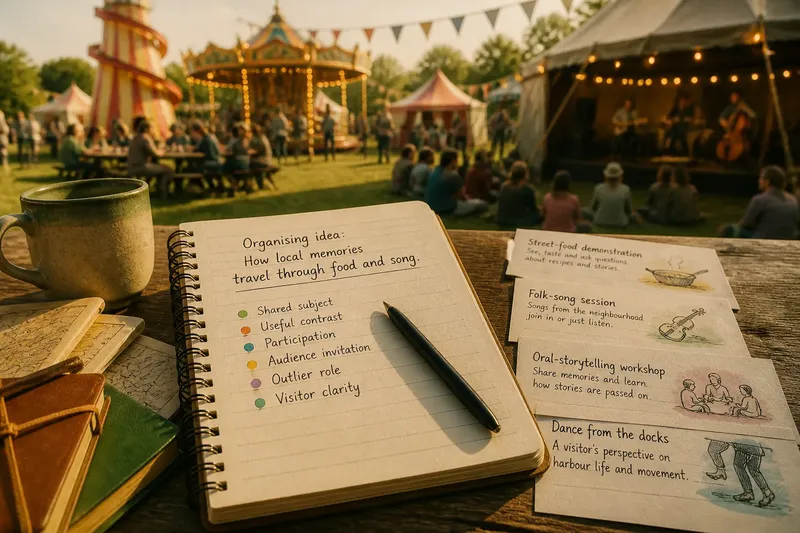
Say you are planning a neighbourhood festival with a street-food demonstration, a folk-song session and an oral-storytelling workshop. You write, “This programme explores how local memories travel through food and song.” The sentence links the demonstration and singing directly; the workshop can join if its stories address that same subject. If it does not, you can revise the sentence, change the workshop’s framing or place it in a separate strand.
Test each selection
Use the following checks to decide whether an event strengthens the offer. An event can contribute through contrast or access as well as direct similarity, but its role should be explainable to a visitor.
- Shared subject: Check whether the event addresses the programme’s stated idea. If it does, describe the connection plainly; if it does not, revise its framing or consider a separate strand.
- Useful contrast: Check whether the event offers a different perspective that deepens the subject. If it does, name that contrast in the listing; if it does not, reconsider its place.
- Participation: Check whether the programme offers more than one way to engage, such as watching, making or discussing. If it does, describe those routes; if it does not, consider adding a suitable format or make the narrower offer explicit.
- Audience invitation: Check whether the description makes clear who can take part and what they will encounter. If it does, retain the wording; if it does not, revise it before publishing.
- Outlier role: Check whether you can explain an apparently separate event without stretching the idea. If you can, state its distinct contribution; if you cannot, move it to a separate strand or remove it.
- Visitor clarity: Check whether someone unfamiliar with the planning can identify a starting point from the listings. If they can, keep the signposting; if they cannot, add clearer grouping or introductory wording.
Explain the choices?
What makes a festival programme curated?
It is curated when events are selected and presented according to an intentional rationale. That rationale may be a subject, community, place or question, rather than a single style.
Does every event need the same theme?
No. Events can differ in form and tone if their relationship to the programme is understandable. A well-chosen contrast can make the central idea more visible.
How can visitors recognise the connection?
Use a short introduction to explain the programme’s organising idea, then give each event a clear description of its activity and subject. Group related listings where that helps visitors spot a shared strand.
What should happen to an event that does not fit?
Decide whether it offers a useful perspective or reaches participants the rest of the programme may not. If neither contribution is clear, revise its framing, move it to a separate strand or leave it out.
Describe each event
A programme introduction should explain the organising idea without making visitors decode planning language. Each listing should name the activity, describe what happens and make the invitation clear.
Adapt the description to the format. A workshop should tell people what they will do; a performance can name its form and subject; a discussion should say what participants will be invited to consider.
Read as a visitor
Ask someone outside the organising group to read the listings and explain what, if anything, connects them. If they identify the intended idea, keep the framing; if they describe a different but useful connection, consider whether the programme supports it; if they see no relationship, clarify the introduction or revise the selection.
The fairground comparison remains useful because it reminds organisers to preserve choice and the pleasure of wandering. Pair that openness with clear descriptions, and visitors can follow their own interests without having to guess why the programme’s events belong together.