A Last-Day Handover That Leaves the Next Team a Clear Start
A last-day handover gives the next festival team a clear start: record open tasks, return shared materials to named places and leave a concise note.
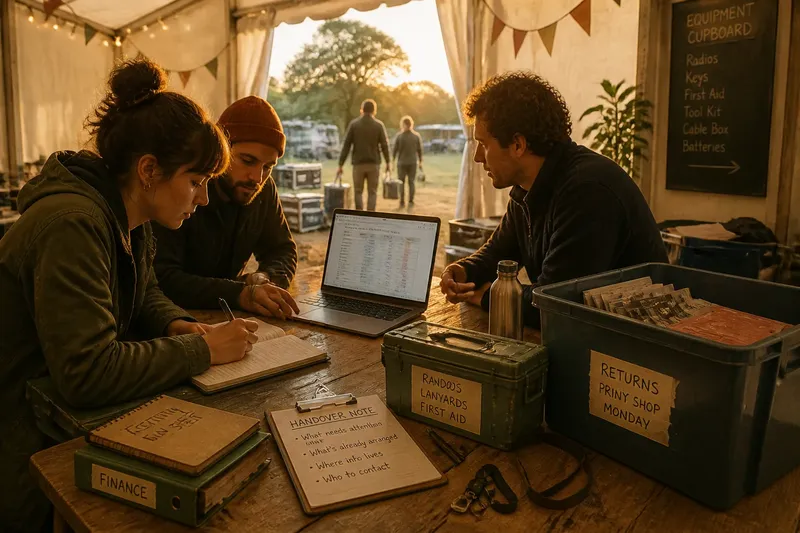
A useful last-day handover turns a festival’s unfinished details into clear next actions, not a pile of messages and half-remembered conversations. The next team should be able to see what remains open, where shared materials belong and whom to ask before work resumes.
That clarity matters because close-out often happens while people are tired, venues are emptying and several teams are packing at once. A handover does not need to settle every question; it needs to make the status of each question visible, with enough context for someone else to take it forward.
Define the handover
A handover is a short transfer of responsibility and information from the team finishing its work to the people continuing it. For a festival, it may cover a venue booking that still needs confirmation, a borrowed banner awaiting collection, or a supplier query that has not been answered.
It is different from a full event report. A report reflects on what happened; a handover helps someone act next. Keep those purposes separate so the urgent operational details do not disappear inside a broad account of the festival.
Choose one shared place for the working handover, such as a team drive document or a clearly labelled folder in the organisation’s existing system. Use a location the next team can access, rather than a personal notebook or a message thread that may be hard to find later.
Capture open tasks
Start by walking through the areas that have generated work: programme, venue, access, communications, equipment and finance. Ask each responsible person for unresolved items, then check the relevant shared records for anything that has no clear owner or status.
For each open task, record the action needed, its current position, the next person or role responsible, and any useful deadline or dependency. A dependency is something that must happen before the task can move, such as receiving a venue reply before confirming a public announcement.
- Task: describe the next action, not just the topic.
- Status: say what has happened and what has not.
- Owner: name a person or role that has agreed to continue it.
- Context: add the relevant contact, document or decision already made.
- Next check: indicate when or under what condition the owner should revisit it.
“Venue” is too broad to help someone take over. “Ask the venue coordinator whether the side room can be held for the volunteer briefing; the request is sent, and no reply has arrived” identifies both the action and the current status.
Say you are closing a small festival and the print team still has an uncollected box of programme leaflets. You record the box’s location, the person who will contact the print shop and the point at which they should follow up; the next team can then act without searching the venue or reopening old chats.
Separate facts from guesses
A handover loses value when a possibility is written as though it were settled. Mark whether a detail is confirmed, awaiting a response or an assumption that needs checking. This lets the next person judge how much reliance to place on it.
Preserve the decision trail only where it changes the next action. If the team chose a particular delivery time because the loading entrance closes early, note that constraint; there is little need to copy every discussion that led to it.
Use plain language for uncertainty. “The supplier has not confirmed collection” is more useful than “collection should be fine”, which can sound like a completed arrangement despite the lack of confirmation.
Return shared materials
Shared materials include more than equipment. They may be keys, radios, access lanyards, signage, reusable decorations, first-aid supplies, printed forms or digital files. The aim is to return each item to a named place and make its condition or outstanding need easy to see.
Agree on a destination that the next team can recognise, such as the labelled equipment cupboard or the organisation’s shared drive folder. Avoid descriptions such as “back in storage” if there are several storage areas, or “in the usual place” if temporary staff may not know what that means.
For physical items, note anything that could affect future use: a missing part, a damaged case, a key that has not been returned or stock that needs replenishing. Do not disguise a problem by putting the item away without a note; the next person may otherwise discover it when time is tight.
For digital materials, use the agreed shared location and a descriptive file name. If an important document exists only in someone’s inbox or personal account, say so and identify who can help move or retrieve it. Do not include passwords in a general handover note; use the organisation’s approved access process.
When an item belongs to a venue, supplier or partner, record its return or collection status rather than treating it as festival stock. If collection is still pending, name the contact and the next action so responsibility does not vanish with the departing crew.
Write the next note
Once the task list and material locations are clear, write a concise note for the person taking over. Lead with the current state of the work, then point to the open-task record and flag any immediate decision or dependency. Keep background brief and link to fuller records instead of copying them into the note.
A useful note answers three questions: what needs attention first, what is already arranged, and where the supporting information lives. It should also identify the right contact for a question that cannot be answered from the files.
Imagine the next team member opening the note before their first planning meeting. If they can identify the pending venue reply, find the relevant correspondence and see who will follow up, the note has done its job; a long narrative of the festival’s final afternoon would not add much.
Keep access and privacy in mind. Share only information the receiving team needs, and place sensitive personal or financial details in the organisation’s appropriate restricted system rather than a broadly shared document.
Who needs what next?
How much detail belongs in a handover?
Include enough to identify the next action, current status, owner and relevant source. Leave out background that does not alter what the next person should do, and link to a fuller record when the context matters.
What if no one has accepted a task?
Mark it as unassigned rather than attaching a name without agreement. Identify who will allocate it or raise it with the appropriate lead, so an open responsibility stays visible instead of appearing settled.
Should the handover include completed work?
Include completed items only when the next team needs evidence or a location, such as a signed venue form or returned key. Otherwise, keep the focus on open work and decisions that affect what happens next.
How should a late change be recorded?
Update the shared handover record and tell the relevant owner directly if the change affects an immediate action. Add what changed and when, so a reader can distinguish the current position from an earlier note.
Check the transfer
Before people leave, ask the incoming lead to scan the handover and identify anything they cannot interpret. A brief conversation can expose vague wording, missing access or an item whose supposed storage place is not actually available to them.
Then confirm that the named owners know about their tasks and that shared materials are either returned or explicitly marked as outstanding. A note alone does not transfer responsibility if nobody knows they are expected to act.
Keep the final record in the team’s established archive, where it can inform the next planning cycle without being mistaken for a current task list. Preserve useful context, but make the date and festival edition clear so old contacts, arrangements or venue details are not treated as current.
For a last-day handover, the most helpful final check is simple: can the next person tell what remains open, where the shared materials are, and who owns the next move? If one answer is missing, add it before closing the working record.